Enhancing Student Achievement
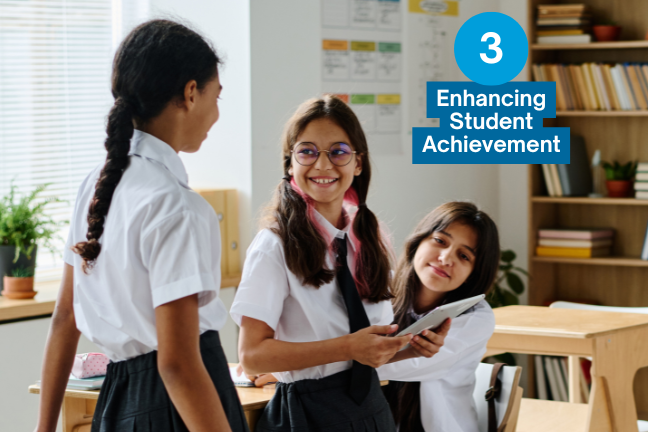
Part 3 of the Edmentum publication, School Improvement Guide: The Building Blocks of Outstanding Schools. Read Part 2, Redefining School Improvement Through Collective Purpose. To access the full guide, click here.
Enhancing student achievement is central to school improvement, and it constitutes a core element in ensuring that educational institutions satisfy their primary purpose—delivering high-quality education and fostering successful student outcomes. Recognising this, the UAE School Inspection Framework (KHDA, 2015) has prioritised student achievement as one of its key performance indicators. Achieving improved outcomes requires a meticulous and focussed approach, characterised by evidence-based strategies, comprehensive data utilisation, and targeted instructional practices tailored to the unique needs of each student.
Data-driven instruction is widely recognized as a pivotal method for elevating student performance. This approach involves the systematic collection, analysis, and application of student performance data to inform and adjust teaching practices. Bryk et al. (2015) emphasise that harnessing data effectively can significantly enhance educational practice by enabling educators to identify students' strengths and weaknesses in real time. Rather than relying solely on traditional standardised tests at the end of an academic year, data-driven approaches allow for continuous assessment and real-time adjustments in teaching strategies. Teachers who implement data-informed instruction are better equipped to identify gaps in student understanding early and apply targeted interventions promptly.
How Leveraging Formative & Summative Assessments Leads to Achievement
Effective use of formative and summative assessments plays a critical role in driving student achievement. Formative assessments, administered frequently throughout instruction, provide teachers with immediate insights into student learning progress, helping educators tailor their lessons to address misunderstandings or reinforce concepts immediately. Day et al. (2016) found that formative assessments significantly enhance student outcomes by creating opportunities for immediate feedback and ongoing instructional adjustments. Conversely, summative assessments evaluate overall learning achievements and mastery at the end of an instructional unit or term, providing educators with vital information regarding student progress relative to set benchmarks and standards.
Implementing Formative & Summative Assessments
Schools successful in improving student achievement consistently leverage both formative and summative assessments strategically. For example, ongoing formative assessments might involve interactive quizzes, classroom discussions, peer assessments, and reflective learning journals, all of which offer real-time feedback and promote deeper learning. Summative assessments, on the other hand, typically involve more structured examinations, standardised tests, or comprehensive project evaluations designed to measure the depth of learning and mastery achieved.
How Ongoing Training and Student Engagement Promote Growth
Sustained improvement in student achievement extends beyond assessments and interventions. It requires embedding a culture of continuous improvement and collaborative professional learning. Teachers must be equipped with professional development opportunities that empower them with the skills to utilise data effectively. According to Bryk et al. (2015), schools that successfully integrate data-driven instruction are those that provide teachers with ongoing training, collaborative planning sessions, and continuous professional support. In these environments, teachers regularly engage in professional learning communities (PLCs), where they collaboratively analyse student data, share best practices, and plan instructional strategies to address student needs comprehensively.
Additionally, engaging students actively in their learning processes significantly enhances achievement. Creating classrooms where students are encouraged to understand their performance data, set personal learning goals, and track their progress has proven effective. Research indicates that when students take ownership of their learning, they are more motivated, engaged, and likely to achieve at higher levels (Day et al., 2016).
Technology also plays a pivotal role in supporting student achievement. Digital tools such as learning analytics platforms, adaptive learning software, and AI-powered tutoring systems can significantly enhance personalised learning experiences. These technologies enable educators to deliver instruction tailored to each student's pace and level of understanding, further supporting individualised and data-informed educational strategies.
Student achievement remains a fundamental measure of school effectiveness and improvement, particularly emphasised within the UAE School Inspection Framework. By systematically employing data-driven instructional strategies, formative and summative assessments, structured interventions, professional development, student engagement practices, and technology integration, schools can significantly elevate student outcomes. Continuous commitment to these evidence-based practices ensures not only short-term improvement but also sustainable academic success, ultimately leading to empowered, capable, and confident learners prepared to thrive in an evolving global landscape.
Reflection questions:
- How effective is your use of formative and summative assessments?
- What factors would be most critical for driving sustained achievement in your school?
- What isn’t working in your school currently? How might you adjust your strategy?
Read Next: Continue to Part 4, Supporting Social and Emotional Development and Innovation Skills
References
Knowledge and Human Development Authority (2015). United Arab Emirates School Inspection Framework 2015–2016. https://www.moe.gov.ae/Ar/ImportantLinks/Inspection/PublishingImages/frameworkbooken.pdf
Bryk, A. S., Gomez, L. M., Grunow, A., & LeMahieu, P. G. (2015). Learning to improve: How America's schools can get better at getting better. Harvard Education Press. https://eric.ed.gov/?id=ED568744
Day, C., Gu, Q., & Sammons, P. (2016). The impact of leadership on student outcomes: How successful school leaders use transformational and instructional strategies to make a difference. Educational Administration Quarterly, 52(2), 221–258. https://doi.org/10.1177/0013161X15616863