Personalized Learning vs. Differentiated Instruction vs. Individualized Learning: Breaking Down the Differences

Understanding the difference between personalized learning, differentiated instruction, and individualized learning is essential for educators navigating today’s classrooms. The terms are often used interchangeably, but they’re actually three distinct approaches, serving different purposes in the classroom.
What they have in common is a focus on placing students at the center of the learning process. Each model has its own unique goals, benefits, and practical elements, and understanding the distinctions can help teachers make more intentional choices about instruction. Let’s break down each one together:
Personalized Learning
Personalized learning is a student-centered instructional philosophy in which students are active participants in their own learning. It gives students a say in what—and how—they learn. In an article for ISTE, Dale Basye, author of Personalized Learning: A Guide for Engaging Students with Technology, put it this way:
“Personalized learning involves the student in the creation of learning activities and relies more heavily on a student’s personal interests and innate curiosity. Instead of education being something that happens to the learner, it is something that occurs as a result of what the student is doing, with the intent of creating engaged students who have truly learned how to learn.”
Personalized learning varies widely from classroom to classroom, and that’s the whole point. By drawing on students’ interests, educators can tap into each student’s learning needs, helping them become metacognitively aware of how they learn best. This awareness fosters self-advocacy and more effective, independent learning.
In practice, personalized learning may include flexible learning pathways, project-based learning, or a student simply choosing reading materials. One student may write an essay, another may create a video, and another might design a digital presentation—all of these activities are aligned to the same academic standard.
Differentiated Instruction
Differentiated instruction is a teacher-driven instructional strategy designed to address varying readiness levels, learning needs, and interests within a classroom. As Carol Ann Tomlinson defines it:
“Differentiation means tailoring instruction to meet individual needs. Whether teachers differentiate content, process, products, or the learning environment, the use of ongoing assessment and flexible grouping makes this a successful approach to instruction.”
With differentiated instruction, students are often working toward the same learning goals, but they’re given multiple pathways to reach them. In an article for Understood, a nonprofit organization that supports and advocates for students who think and learn differently, special education teacher Ginny Osewalt explains:
“Flexible groups are at the heart of differentiated instruction. The same students are not in the same group for every activity or assignment. Each student is moved around according to abilities. Teachers design their lessons around the needs of each group.”
The essential idea is to differentiate instructional methods, content, and learning activities to match students’ differing interests and learning profiles, so that all students can access and engage with the material effectively. Differentiation can show up through the content that’s delivered, the processes students use to make sense of it, or the products they create to demonstrate their understanding.
This approach recognizes that no two classrooms are alike, and no two learners bring the same skills or background knowledge. By building differentiation into lesson design, teachers can make sure that every student has an entry point into the material while still feeling challenged. In this way, differentiation provides varied pathways so all students can succeed and demonstrate mastery.
Individualized Learning
Individualized learning focuses on adjusting the pace of instruction so students can progress based on mastery, rather than time.
According to Greg Kearsley and Richard Culatta, individualized learning “refers to learning experiences in which the pace of learning is adjusted to meet the needs of individual students. In other words, individualized learning focuses on the question of ‘when’ students receive a learning activity. In individualized learning, all students go through the same experience, but they move on at their own individual pace.”
Individualized learning often supports intervention, acceleration, and credit recovery models because it ensures that students are neither held back nor rushed forward before they’re ready. Think of individualized learning as falling under the umbrella of personalized learning in its ability to respond to the individual needs of each student. It’s also frequently supported by adaptive learning platforms that automatically adjust to give students targeted practice and real-time feedback.
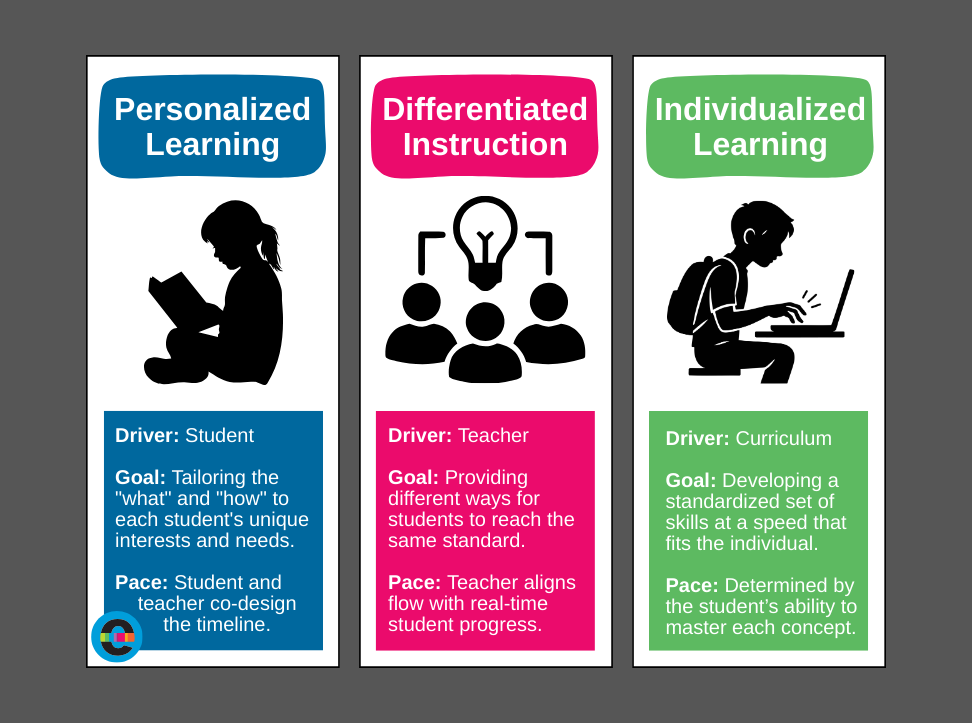
While these approaches are closely related, they address distinct instructional questions:
- Personalized learning: Who is the learner, what motivates them, and what keeps them engaged?
- Differentiated instruction: How should instruction be delivered to meet the needs of all students?
- Individualized learning: When is a student ready to move forward and what’s the best pace for mastery?
Together, these models form the foundation for effective student-centered instruction. When thoughtfully implemented—and regularly assessed for effectiveness—the result is a classroom where every student has the opportunity to thrive.
Edmentum Solutions That Support Student-Centered Learning
Technology can play a crucial role in bringing personalized, differentiated, and individualized learning into K-12 classrooms. Digital platforms make it easier for educators to tailor lessons, track student progress, and provide flexible learning paths that meet each learner’s needs. As schools increasingly adopt AI-supported tools, understanding these models helps ensure that technology continues to support teachers in delivering high-quality, student-centered instruction.
Edmentum provides adaptive learning tools, online curriculum and tutoring options, and assessment platforms that align perfectly with individualized, differentiated, and personalized learning models.
- Exact Path Growth: Evidence-based, diagnostic-driven learning paths and powerful teaching tools to identify skill gaps, support personalized instruction, and scale interventions in K–12 math, reading, and language arts.
- Exact Path Proficiency: Standards-aligned formative assessments and practice in math, ELA, science, and social studies for grades 3-12 to drive core subject standards mastery and assessment readiness.
- Targeted Skills Instruction: High-impact K–12 virtual tutoring that’s aligned to personalized learning pathways and supports acceleration and targeted intervention through flexible implementation models.
Combine Exact Path Growth, Exact Path Proficiency, and Targeted Skills Instruction to create one coherent system that extends the reach and success of intervention while keeping instruction both aligned and manageable.