Shaping APAC’s Global Workforce Through Future-Ready Curriculum: Preparing Students for Tomorrow’s Jobs

by Hendro Widjaya
Across Asia-Pacific, K–12 systems are navigating a decisive moment. APAC economies are powering global growth, technology cycles are compressing, and demographic shifts are reshaping labor markets.
As chair of Indonesia’s Association of National & Private Schools—and through partnerships with schools across Malaysia, Australia, Singapore, China, Thailand, Japan, Korea, and Vietnam—I see both the urgency and the opportunity: our curricula in Kindergarten, Elementary, Middle School, and High School must move beyond content mastery toward capability, character, and cross-border competence. The question for school leaders is simple but profound: what futures are our curricula preparing for, and are our students genuinely ready to compete—and lead—on a global stage?
This article examines, from an Asia-Pacific perspective, the jobs recruiters will prioritize over the next decade and the capabilities K–12 curricula must cultivate so students thrive. It integrates an Indonesia case to ground the discussion, adds a section on assessment and credentials for a skills-based economy, and offers clear implications for school leaders with minimal overlap.

What jobs will APAC recruiters seek?
The APAC talent market is bifurcating rapid automation is displacing routine tasks while demand surges for roles at the intersection of technology, sustainability, healthcare, and human-centered services. Several patterns are clear.
- Technology-adjacent roles will broaden beyond traditional software engineering
Recruiters are prioritizing applied AI and data roles—machine learning operations, AI product management, data engineering—alongside cybersecurity, cloud and edge computing, and human–AI interaction. These roles increasingly require sector fluency in finance, manufacturing, logistics, health, and public services. McKinsey estimates that up to half of work activities could be automated with current technology, raising demand for new skills and creating net new roles in AI governance, human–AI collaboration, and systems integration (McKinsey Global Institute, “The future of work after COVID-19,” 2021)
- Green transition careers will accelerate.
As governments and firms commit to net-zero targets, we will see growth in renewable energy engineering, energy systems modeling, climate risk analytics, sustainable finance, circular design, environmental auditing, and green construction. ILO and ADB analyses indicate millions of green jobs will be created in the region through investments in clean energy, transport, and resilient infrastructure (ILO, “Skills for a greener future,” 2019; ADB, “Asia’s Journey to Prosperity,” 2020).
- Health and care economies will expand.
With aging populations in high-income APAC and rising chronic disease burdens elsewhere, recruiters will seek clinical professionals, digital health analysts, biomedical engineers, mental health counselors, rehabilitation specialists, and public health data scientists. WHO and OECD highlight digital health literacy and interoperable data skills as key enablers.
- Advanced manufacturing and supply-chain roles are being reconfigured by robotics, IoT, and analytics.
APAC’s manufacturing hubs are investing in smart factories, creating demand for mechatronics technicians, industrial data engineers, human–robot interaction designers, and reliability and safety professionals who combine systems thinking with quality mindsets.
- Creative and cultural industries are scaling with technology
APAC’s media, streaming, and gaming sectors need technical artists, narrative designers, AR/VR developers, music tech producers, and rights managers. As generative AI transforms content workflows, roles that blend creativity, ethics, and brand strategy will rise.
- “Human +” roles remail resilient.
Finally, human+” roles remain resilient. Deloitte and the World Economic Forum consistently find that complex problem-solving, critical thinking, collaboration, communication, and socio-emotional skills are expanding in value as automation grows. Education must therefore prepare learners to work with AI, not compete against it.
UNESCO’s Futures of Education Commission captures the imperative: “We should reimagine how knowledge and learning can shape the future of humanity and the planet” (UNESCO, “Reimagining our futures together,” 2021). That reimagination in APAC requires K–12 curricula aligned to regional labor dynamics and global citizenship.
Indonesia case: momentum, gaps, and a pathway
Indonesia, Southeast Asia’s largest economy, illustrates the APAC opportunity and challenge. With a young, dynamic population and rapid digital adoption, Indonesia is projected to add significant numbers of digital jobs over the next decade, driven by e-commerce, fintech, logistics, health tech, and green infrastructure. At the same time, the system must close foundational learning gaps, universalize connectivity, and accelerate teacher upskilling to translate potential into productivity.
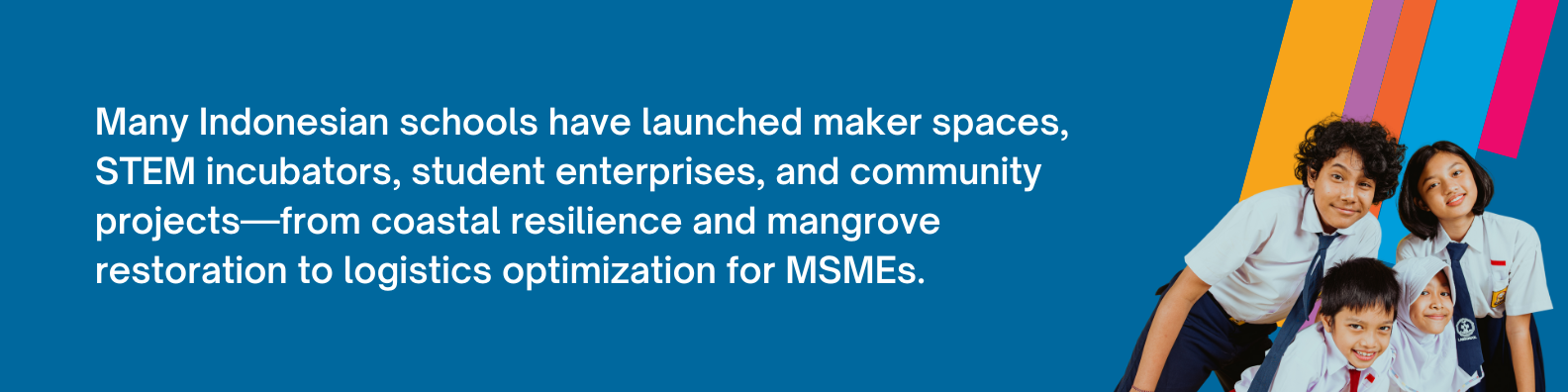
On momentum: international and national private schools in Indonesia are aligning with IB, Cambridge, Pearson, Oxford, ICA, Common Core and the national curriculum Merdeka competencies. Kindergarten and Elementary programs increasingly emphasize play-based inquiry, early numeracy and literacy, and social-emotional learning. Middle School integrates computational thinking and project-based learning, while High School layers capstones, service-learning, and internships. Many schools have launched maker spaces, STEM incubators, student enterprises, and community projects—from coastal resilience and mangrove restoration to logistics optimization for MSMEs. University and industry partnerships are growing, helped by Indonesia’s startup ecosystem and the country’s role in regional supply chains. Cross-border collaborations with schools in neighboring countries have catalyzed leadership development, comparative curriculum design, and exchange of best practices.
On gaps: access remains uneven between metropolitan and rural or remote communities, particularly in Eastern Indonesia. Device and broadband constraints can limit participation in data-rich and AI-enabled learning. Assessment practices often overemphasize recall, and teacher professional development, while improving, is not yet consistently job-embedded with coaching cycles. Computational thinking and data literacy are present but not always vertically articulated from early years through upper secondary.
A pathway forward for Indonesia includes three moves:
- Codify a national “future-ready graduate profile” that translates into unit plans, rubrics, and moderated performance tasks – ensuring competencies like digital fluency, sustainability literacy, and collaboration are explicitly taught and evidenced.
- Scale practice-based teacher learning communities that plan, observe, and refine lessons aligned to those competencies, using short coaching cycles and shared assessments.
- Close the access gap through device refurbishing programs, community digital hubs, and curated offline or low-bandwidth learning resources, ensuring students beyond Java benefit from future-ready pedagogy. These moves align with UNESCO’s emphasis on learner agency and equity as the foundation for transformation (UNESCO, 2021).
How students thrive in an evolving APAC landscape
Students flourish when three conditions are routine.
- Authentic, applied learning connects classroom work to local and regional challenges through real datasets, community briefs, and industry partnerships, relevance drives motivation and transfer.
- Deliberate practice of human+ skills with AI builds advantage: learners document how they use AI tools, verify outputs with sources, detect bias, and reflect on their reasoning, turning AI into a productivity and metacognitive partner rather than a shortcut.
- Strong wellbeing and guidance underpin performance: advisory programs teach goal setting, stress management, digital citizenship, and career exploration, while inclusive support ensure all learners—from Kindergarten to High School—can participate fully.
These student habits complement system-level reforms and prepare graduates to collaborate across borders and disciplines.
Implications for school leaders
The task now is to move from isolated innovations to system-level practice. School leaders can act on seven strategic priorities that translate future-ready aspirations into measurable gains.
- Embed a competency-based, adaptive curriculum.
Use frameworks such as the OECD Learning Compass 2030 to anchor agency, well-being, ethics, and adaptability, then map these competencies across IB, Cambridge, Pearson, Oxford, ICA, Common Core and national programs to unify planning and assessment. Coherent competency maps and common rubrics enable vertical progresssion and reliable moderation (OECD, Future of Education and Skills 2030).
- Integrate AI, digital, and sustainability literacy across subjects
Establish progression maps from early years to senior years that embed data literacy, computational thinking, responsible AI use, climate literacy, and systems thinking through interdisciplinary projects and authentic problems. Treat these as cross-curricular capabilities, not stand-alone topics (UNESCO, AI in Education; UNESCO, GCED).
- Co-create with industry, government, and higher education.
Formalize advisory boards and partnership pipelines so units, capstones, internships, and teacher externships align with labor market needs and regional priorities. Invite partners to validate competency rubrics, contribute datasets and briefs, and co-assess student work, ensuring relevance and rigor.
- Advance inclusive access to future-ready learning.
Invest in connectivity, devices, shared maker labs, and teacher training for blended and differentiated instruction. Target support for marginalized, rural, and remote communities to ensure equity alongside excellence. Equity measures expand the talent pool and underpin social cohesion (UNESCO, Reimagining our futures together).
- Evidence competencies through certification and micro-credentials.
Issue digital badges and moderated portfolios that certify mastery in domains such as data storytelling, sustainability leadership, collaboration, and design. Align these to emerging skills-based hiring practices so graduates present transparent, verifiable evidence to recruiters.
- Build teacher capacity and adaptive pedagogy.
Commit to continuous, job-embedded professional learning: collaborative planning, lesson study, coaching cycles, and externships. Focus on interdisciplinary design, technology integration, assessment literacy, and inclusive strategies. Teacher professionalism and collaborative cultures correlate strongly with student outcomes (OECD research).
- Monitor and communicate progress with shared indicators.
Track growth on targeted competencies and align reporting to SDG 4—especially 4.4 (digital skills), 4.7 (global citizenship and sustainability), and 4.a (safe, inclusive, technology-enabled environments). Publish dashboards to build transparency, trust, and accountability (UNESCO Institute for Statistics).

A candid readiness verdict
Is APAC ready to compete globally? In many systems and schools, yes—and getting stronger. The region has unmatched diversity, entrepreneurial energy, and technological adoption. Indonesia’s national and private schools, in concert with regional partners, are innovating K–12 curricula and pedagogy at pace, aligning with IB, Cambridge, Pearson, Oxford, ICA, and national frameworks that emphasize inquiry, global mindedness, and rigorous assessment.
But readiness is not uniform. To compete and lead globally, we must lift the floor while raising the ceiling: guarantee foundational literacy and numeracy, universalize digital access, embed data and AI fluency across the curriculum, and assess human skills with the same seriousness as content. This is not a five-year project; it is the ongoing work of schooling.
As UNESCO reminds us, “Education is a public endeavor and a common good” (UNESCO, 2021). In APAC—and in Indonesia—this endeavor is also a strategic advantage. If we align our K–12 curricula with the emerging economy, invest in teachers, and give students authentic, cross-border learning experiences, our graduates will not only be ready for the jobs recruiters seek—they will create the jobs the world needs.
About the Author
Hendro Widjaya is the Chairman of the Association of National & Private Schools (ANPS) Indonesia, representing international and national private schools across the country. With over 20 years of experience across K–12 schools, higher education, and education consultancy, he also serves as Superintendent of Bina Bangsa Schools, where he oversees six international campuses in Jakarta, Bandung, Semarang, Balikpapan, and Malang. A respected voice in global education, Hendro is a regular speaker at international conferences and has built strong partnerships with education leaders across APAC and beyond. He is deeply committed to advancing future-ready learning and empowering students to thrive as adaptable, purpose-driven global citizens.
Citations
- Asian Development Bank. (2020). Asia’s Journey to Prosperity: Policy, Market, and Technology Over 50 Years. Manila: ADB.
- International Labour Organization. (2019). Skills for a Greener Future: A Global View Based on 32 Country Studies. Geneva: ILO.
- McKinsey Global Institute. (2018). Skill Shift: Automation and the Future of the Workforce. McKinsey & Company.
- McKinsey Global Institute. (2021). The Future of Work after COVID-19. McKinsey & Company.
- OECD. (2019–2023). The Future of Education and Skills 2030: OECD Learning Compass 2030 (conceptual learning framework and series). Paris: Organisation for Economic Co-operation and Development.
- OECD. (2019). Teachers’ Professional Learning and Development: TALIS 2018 Results (Volume II). Paris: Organisation for Economic Co-operation and Development.
- UNESCO. (2015). Global Citizenship Education: Topics and Learning Objectives. Paris: United Nations Educational, Scientific and Cultural Organization.
- UNESCO. (2021). AI and Education: Guidance for Policy-makers. Paris: United Nations Educational, Scientific and Cultural Organization.
- UNESCO. (2021). Reimagining Our Futures Together: A New Social Contract for Education. Paris: United Nations Educational, Scientific and Cultural Organization.
- UNESCO Institute for Statistics. (ongoing). SDG 4 Data and Indicators: Ensure Inclusive and Equitable Quality Education and Promote Lifelong Learning Opportunities for All. Montreal: UIS.
- WHO. (2021). Global Standards for Health-promoting Schools: A Framework for Implementation. Geneva: World Health Organization.
- WHO & OECD. (2023). Health at a Glance: Asia/Pacific 2022 (focus on digital health and resilience). Paris: OECD Publishing; Geneva: WHO.
- World Economic Forum. (2023). Future of Jobs Report 2023. Geneva: WEF.
- Ministry of Education, Culture, Research, and Technology (Indonesia). (2022). Kurikulum Merdeka: Pedoman Implementasi Kurikulum. Jakarta: Kemendikbudristek.
- World Bank. (2020). The Promise of Education in Indonesia. Washington, DC: World Bank.