
Why ICAP Implementation Often Falls Short, and How Districts Can Make it Work at Scale

In more than 30 states, Individualized Career and Academic Plans (ICAPs)—also known as Individual Learning Plans (ILPs), Individual Graduation Plans (IGPs), and Academic and Career Plans (ACPs)—are a graduation requirement. The expectation is the same: every student should build and maintain a plan that connects their interests to courses, pathways, and what comes next.
But in practice, completion is far less consistent.
In most districts, participation in career planning still varies more than anyone wants to admit. Some students build clear direction. Others complete the minimum. And some fall through the cracks entirely, depending on the school, the program, or how much time is available to support them.
That inconsistency is the real issue. On paper, these plans exist, but they don’t consistently translate into clear direction for every student.
Of course, this isn’t for lack of effort. Career planning is still largely driven by people. Counselors guide students, follow up on tasks, and try to keep the process moving. But with large caseloads and competing priorities, even strong programs run into the same constraint: There’s no reliable way to ensure every student completes the process in a consistent, substantive way.
Expectations, however, are increasing.
It’s no longer enough to show that students had access to planning tools or completed required activities. Districts are increasingly expected to show that students have direction—and that their plans connect to real decisions.

Course selection makes this challenge even more visible. By the time schedules are finalized, many students have already made decisions without a clear sense of how those choices connect to their future.
When courses aren’t aligned to student interests or goals, engagement drops and students are less likely to stick with them. At the same time, districts are left without a clear signal of what students actually want—making it difficult to build programs and pathways that reflect real demand.
The plan may exist, but it isn’t shaping the outcome.
For many schools, that’s the gap: Plans are in place, but they don’t consistently reach every student in a way that drives solid decisions.
What It Takes to Make ICAPs Work at Scale
For most districts, the challenge isn’t access to career planning. It’s ensuring every student moves through the process and ends with a clear outcome.
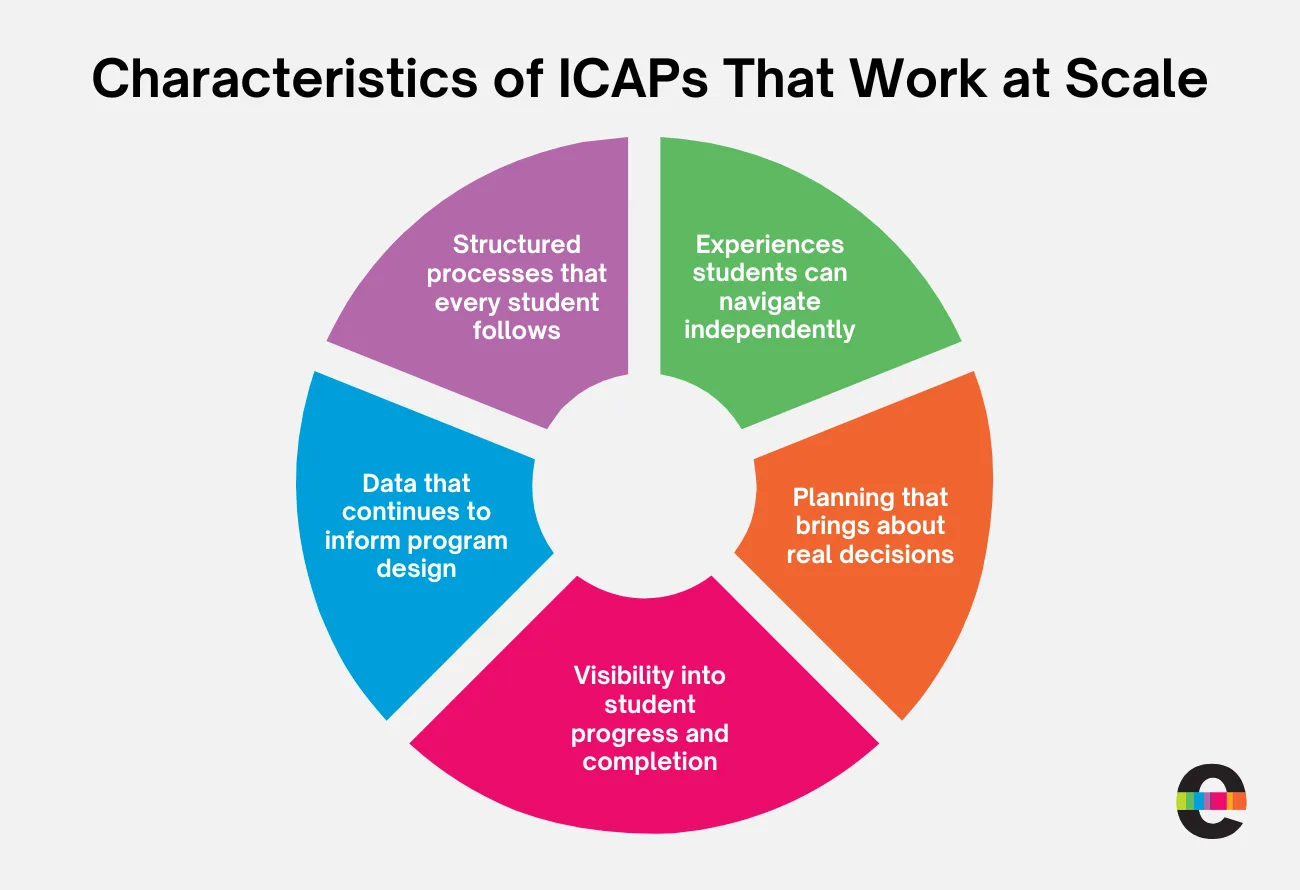
Programs that scale tend to share a few common characteristics:
1) A structured process every student follows
When the process is loosely guided, participation varies and outcomes become uneven. Students need a defined progression, from exploration to decision-making to a completed plan.
2) An experience students can navigate independently
When career planning depends entirely on counselor time, it becomes difficult to scale. Shifting key steps to students increases participation without adding staff burden.
3) Planning that informs real decisions
Career planning should directly influence course selection, pathways, and next steps. Without that connection, plans exist separately from the choices students make.
4) Visibility into progress and completion
Districts need to see which students have completed plans and where gaps remain. Without that visibility, it’s difficult to ensure consistency across schools and student groups.
5) Data that informs program design
Student planning data should inform course offerings, pathways, and staffing. When districts understand what students are choosing, they can better align programs to real demand.
These elements turn career planning from a requirement into something students actually use—and districts can stand behind.
How Districts Are Scaling ICAP Completion With Career Exploration Technology
In a discussion with administrators at Rockingham County Schools in North Carolina, career development coordinator Christie Hensley shared that she likes seeing students’ career development plans change as they're exposed to new courses, extracurricular activities, and other opportunities through the district’s career exploration platform.
“That plan is something that the student can be very proud of,” she said, “and it helps make their decisions for next steps more concrete.”
A CTE director at a large Virginia district said his students are excited about the progress they’ve made with career-connected learning. The district uses a platform that supports each student’s career exploration journey, even as their interests and understanding of potential pathways evolve, and some students are independently accessing the resources late at night and on weekends. As they navigate the platform over time, they create dynamic roadmaps that give counselors and families rich insight to review and discuss as they all work together to set each learner up for long-term success.
“If we provide students an opportunity to have access to information as they grow, mature, and change their perspectives, all in one platform,” the CTE director said, “it’s a home run.”
- See how MajorClarity can help your school or district ensure that every student builds a meaningful career plan—without adding to counselor workload.
- For more information on where each state stands with ICAP/ILP mandates, visit our state-by-state guide.