
From Awareness to Readiness: Career-Connected Learning Grows with Students in a Large Virginia District

Location:
Large school district in Virginia
About the District
More than 60,000 students; 90% graduation rate
Edmentum Products:
MajorClarity
Key Takeaways for Districts:
- Career-connected learning is most effective when it can develop over time. Students benefit when career awareness starts with early exposure, builds through exploration, and matures into readiness as they mature. A consistent framework across grade levels gives them the space they need to revisit their interests and change direction when needed.
- Continuity makes a difference in the long term. Rather than layering multiple career learning tools, schools can benefit from using a single platform from middle school through graduation to preserve student history and create a shared foundation for students, counselors, and teachers.
- Student voice and employer feedback can shape CTE offerings. By analyzing student interest data and gathering structured employer feedback each year, districts can align course offerings and work-based learning experiences with real-world demand, creating stronger partnerships, more relevant electives, and clearer pathways to postsecondary opportunities.

In many school districts, career-connected learning is sporadic. Students may attend a career fair in middle school or complete an interest survey during freshman year, often on a platform they’ll never use again. By the time they reach graduation, much of their early exploration has vanished, replaced by last-minute college decisions and uncertain next steps.
At a large school district in Virginia, the experience is very different for students in grades 5-12. For them, career learning is a continuous, highly personalized process that evolves with them as they grow.
“We wanted something that students could use from elementary school through middle school through high school,” explained the district’s CTE director. “So it’s not one app, and then another app, and then another app...”
Instead, they’re using MajorClarity, a cohesive college and career planning platform that helps students explore their options, build informed academic plans, and prepare for life after high school. And because they first rolled it out several years ago, many of today’s high school students have been using MajorClarity since middle school, giving the district valuable insight into how well it’s working.
Starting Career Awareness Early, Without the Pressure
Virginia requires districts to support both academic and career planning, along with a formal career investigations course. the district recognized early on that compliance alone would not be enough, and that career exploration needed to be age appropriate, structured, and sustained.
In fifth grade, they introduce students to career clusters, simply to give them some basic exposure and foundational learning. “All we’re doing there is making students aware of the clusters and the careers,” the CTE director said. “We’re not doing anything beyond that.”
In sixth grade, counselors revisit those ideas, and by seventh grade, students start to engage in deeper investigation through structured coursework that includes student profiles, aptitude assessments, and career research. And by the end of middle school, each student has identified:
- A personalized academic and career plan
- Three potential areas of career focus
- Preliminary pathways aligned to high school course options
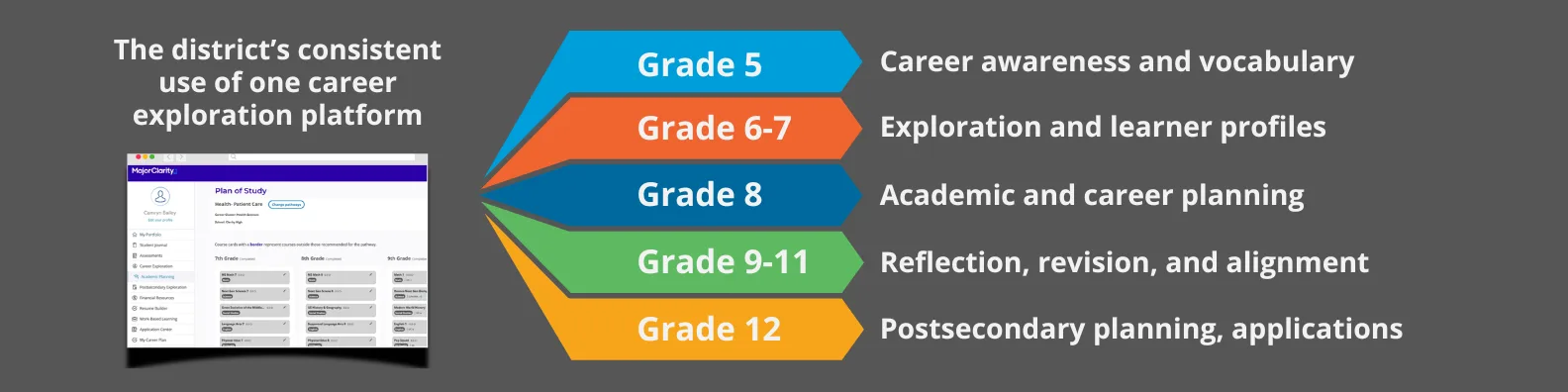
Those decisions help many students clarify their direction as they prepare to apply to focused programs in areas like leadership, language immersion, and health sciences.
What makes this system work so smoothly is its continuity. Students don't need to start over each year; their prior work follows them, and they can continue to reflect and build on what they’ve done.
“They’re able to go back and see what they thought when they were in sixth and seventh grade versus now where they are as a sophomore or junior,” the CTE director said. “That’s a really cool thing.”
Designed for Students to Change Their Minds
As one might imagine, many (if not most) of the students end up changing their intended career focus at some point between middle school and high school. The district sees that shift as evidence that the system is working.
One student originally planned to pursue civil engineering before pivoting to chemical engineering as his coursework and interests evolved. “He’s no longer a sixth grader,” the CTE director said. “He’s now a high school junior and wants to do something different.”
Because the student's career exploration history remained visible, educators could actually trace how and when that change had occurred. The platform preserves the evolution, empowering the district to leverage reflection, revision, and informed choice to help every student create a personalized pathway based on their own discovery.
Aligning Course Offerings with Student Data
As thousands of middle school students documented their interests year after year, district leaders began to notice some interesting patterns. For instance, high schools could see, empirically, what incoming students were interested in pursuing.
“And now we have some high school principals going, ‘We should probably listen to those kids,’” the CTE director said, “’And we should probably offer courses that align to that.’”
In some schools, interest in engineering rose where middle school technology education was strong. In others, business administration or arts and entertainment dominated. As students are exposed to different types of content, they become better able to connect to learning in areas where they might not have otherwise had an interest, the CTE director explained.
Several schools have since adjusted elective offerings for incoming freshmen based on those trends, allowing course catalogs to respond directly to student voice rather than historical assumptions.
Work-Based Learning at Scale
Career exploration doesn’t stop at interest surveys. The district's model places heavy emphasis on work-based learning, which involves everything from guest speakers to extended internships. In a single year, the district recorded:
- More than 30,000 total work-based learning experiences
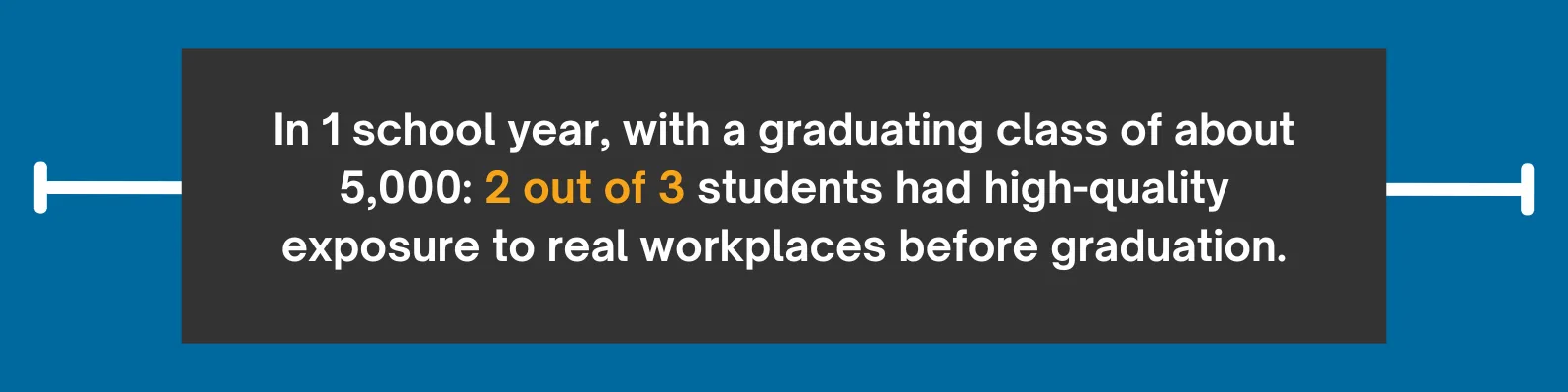
- Nearly 3,000 high-quality experiences of 90 hours or more
- A graduating class of approximately 5,000 students
That means roughly two-thirds of students had meaningful exposure to real workplaces before graduation, and those experiences aren’t limited to traditional CTE fields.
“If you want to be a chemist, we can get you into a local company hiring chemists,” the CTE director said. “If you want to be a journalist, we can get you on the local news or with the newspaper. What I care about is that we give students an opportunity to explore a career outside of the school, and affirm ‘yes, this is for me’ or ‘no, this isn’t for me.’”
Listening to Local Employers
Each spring, the district gathers feedback from employer partners on student readiness. The CTE director calls it gut-check season. “That’s where we hear back from our employers how prepared our students were, how aligned our students were, and what they need from us to pivot for the next class,” he said.
That feedback informs curriculum updates over the summer, so students arrive better prepared the following year— and when districts respond quickly, the partnerships deepen.
The process also addresses what the CTE director sees as a national disconnect between how students perceive work and how entry-level employment actually functions. Closing that gap requires ongoing calibration on both sides.
The Pivots Are the Point
The CTE director shared the story of a middle school student who met a female engineer during a guest speaker session. Inspired, she built her academic and career plan around engineering, although she had never even considered it as a career path.
Years later, the same engineer returned to her high school classroom. The student requested a job shadow, which led to an internship, then a paid internship, and ultimately a scholarship.
After earning her engineering degree, the student returned to the same firm, and in the summer of 2025, she spent the summer leading the intern program for high school students, giving back to the school where her journey had begun.
Another student had entered clinical placements, convinced that she wanted to become a nurse. After realizing bedside care was not the right fit, she pivoted into medical coding and billing and now holds a senior role with a regional hospital system.
Those pivots, district leaders say, are the point.
“They’re digging into it themselves”
With roughly 40,000 students, hundreds of counselors and teachers, and eight grade levels actively using the same system, the district plans to continue their momentum with career-connected learning.
Through MajorClarity, the district can now support academic and career planning, work-based learning documentation, FAFSA completion, and Common App integration within a single platform, allowing students to manage postsecondary planning without having to navigate disconnected systems.
In addition, the CTE director said, students are accessing career resources late at night and on weekends, and some remain active for hours at a time, revisiting plans and researching colleges. “They’re digging into it themselves,” he added. “That’s a glorious thing.”
A Career Exploration Model Built for Growth
For this large school district, career-connected learning is far from being a one-year initiative or a graduation requirement. It’s a long-term commitment to helping students develop a deep understanding of who they are, what they value, and how their interests have changed over time.
“If we provide students an opportunity to have access to information as they grow, mature and change their perspectives all in one platform,” the CTE director said, “it’s a home run.”
Not because it dictates their future, but because it gives students room to discover it.