6 Texas Education Policy Updates from the 2025 Legislative Session
Texas’s 2025 legislative session officially concluded with 1,155 bills signed into law and 28 vetoed. This session saw significant movement on education policy, including increased public education funding and the long-debated passage of the state’s first private school voucher program. Below are some key highlights from this year’s education-related legislation that offer both new opportunities and important planning considerations for the months ahead:
Pathways & P-TECH Expansion: HB 120 – Rural Pathway Excellence Partnership (R-PEP)
New investments in career-connected learning and small district partnerships
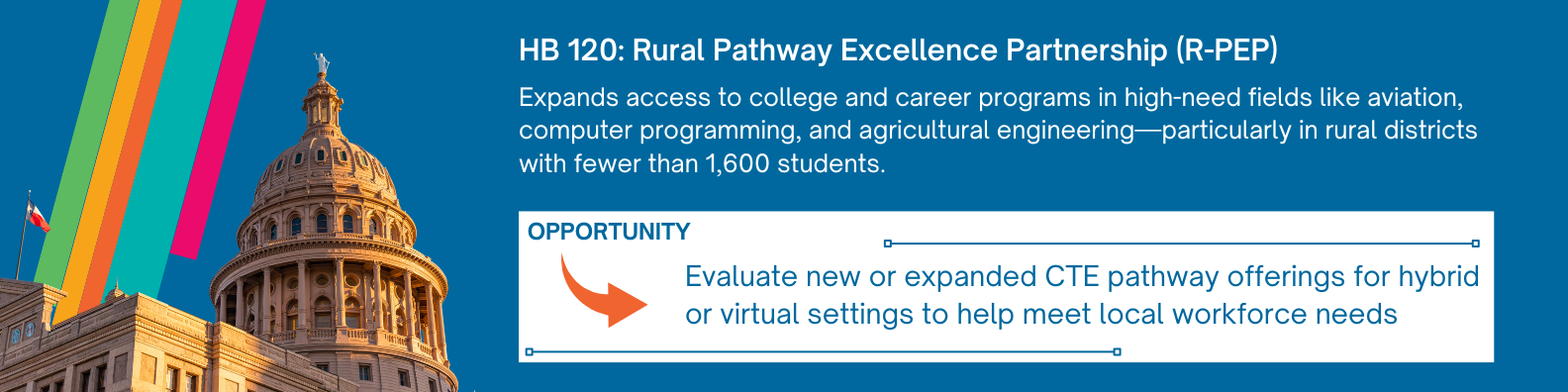
The Rural Pathway Excellence Partnership (R-PEP) expands access to college and career programs in high-need fields like aviation, computer programming, and agricultural engineering—particularly in rural districts with fewer than 1,600 students. The bill also triples P-TECH per-student funding from $50 to $150 and provides new dollars for college and career counseling.
Takeaways:
- This is a good time to evaluate new or expanded CTE pathway offerings for hybrid or virtual settings to help meet local workforce needs.
- The increase in per-student P-TECH funding may support scaling existing programs or piloting new ones in high-demand fields.
- Counseling departments may be able to strengthen college and career guidance with the additional funding now available.
Private School Vouchers: SB 2 – Education Savings Accounts (ESA)
Education Savings Accounts are coming in 2026–27
The ESA program will allow families to use public dollars for a range of education expenses, including private school tuition. While implementation is still a year out, public schools will receive a 10% basic allotment supplement for each student who exits—and can even apply to serve their students as an ESA provider.
Considerations:
- With rollout expected to begin gradually over the coming year, districts may want to begin tracking potential enrollment impacts and community interest in ESAs.
- Becoming an ESA provider could offer a way to serve families who leave the system—while retaining some funding.
- Reviewing current offerings with a lens toward flexibility and personalization may help strengthen your value proposition.
Virtual Education Overhaul: SB 569
Virtual and hybrid learning now stand on equal footing with traditional models
This bill ensures that both full- and part-time virtual learners are funded at the same level as in-person students. However, districts must now go through a forthcoming TEA approval process to operate full-time virtual or hybrid programs. Grants will be available to help launch new virtual schools.
Considerations:
- Districts currently offering—or considering—virtual options may want to keep an eye on TEA’s approval process and criteria. Ensuring that virtual models align to TEA’s standards will be essential for long-term sustainability.
- Development grants could be a valuable opportunity to enhance digital learning models, especially where staffing or access is a concern.
K–12 Funding & State Budget: SB 2
Budget increase with specific goals for literacy, credentials, and staffing
Schools will benefit from an increased basic allotment and new operational funds for transportation, employee benefits, utilities, and re-hiring retired educators. The Teacher Incentive Allotment (TIA) is also expanding to include more instructors.
SB 2 also puts new emphasis on career readiness, directing TEA to establish a statewide goal tied to industry-recognized high school credentials. To support that effort, the bill increases reimbursement for up to two certification exams per student, helping districts offset the cost of credentialing.
On the literacy front, SB 2 offers ADA incentives to districts that provide up to 30 additional half-days of reading instruction. It also introduces parent grants for families of students in grades 1–3 who require reading intervention, allowing them to access tutoring from TEA-approved providers. These changes come alongside new requirements around the scope, duration, and delivery of reading interventions, reinforcing the state’s commitment to early literacy. Taken together, these updates offer both immediate funding relief and longer-term goals around instruction, talent, and student readiness.
Considerations:
- This is an opportunity to audit your current supports and prepare for sustainable implementation in 2025–26.
- New operational dollars may allow districts to reinvest in critical supports impacted by inflation or staffing shortfalls.
- Instructional teams may want to review intervention frameworks and literacy programs to ensure alignment with new state guidelines.
- With increased reimbursement and state emphasis on credentials, there may be an opportunity to expand industry certification offerings.
Special Education Funding Reform: SB 568
A shift toward service-based funding and stronger CCMR incentives
This legislation transitions special education funding from a classroom-based to a service-based model to better reflect individual student needs. It also doubles College, Career, and Military Readiness (CCMR) outcomes bonuses for students receiving special education services.
Considerations:
- Special education teams may want to evaluate how the shift in funding affects staffing models and service delivery.
- Expanded CCMR bonuses could encourage more strategic alignment between IEP goals and college, career, and military readiness pathways.
Assessment Reform – Stalled for Now
A through-year testing model was proposed but didn’t pass
HB 4, which would have replaced the STAAR exam with a through-year assessment model, failed due to differences between the House and Senate. Still, assessment reform remains a live issue, with similar bills expected in future sessions.
Looking Ahead
While the legislature won’t hold a regular session in 2026, interim committee work and bill development will continue. Check out TEA's legislative implementation page with rolling guidance and a schedule of anticipating rulemaking by bill. In the meantime, districts should begin planning for opportunities to expand literacy intervention, industry certification preparation, and virtual learning.
As you look toward the 2025–26 and 2026–27 school years, Edmentum stands ready to support your next steps:
- Address new reading mandates with ESSA-backed literacy intervention, including diagnostic assessments, high-impact tutoring, and progress monitoring that align with state expectations for grades 1–3 reading support.
- Expand career-connected learning with flexible CTE pathways, industry-recognized certification prep, and career exploration tools to strengthen college and career counseling—ideal for planning under HB 120 and CCMR performance goals.
- Plan for virtual expansion with our turnkey virtual instruction solution staffed by Texas-certified teachers. Districts across the country have partnered with Edmentum to launch turnkey virtual programs that retain enrollment, address staffing gaps, and expand access to flexible learning models. As TEA prepares to roll out new virtual school requirements and ESA vendor opportunities, we can help you build a flexible option that fits your school and district goals.
Texas’s education landscape is evolving quickly—but with a strategic partner, districts can adapt with confidence. Our team's consultative approach can help you navigate what’s next. Contact us for more information.