“We’ve Got to Build New Ships” – Richard Gerver’s Masterclass on Change Leadership

Why is change so difficult in schools—and how can school and district leaders make change efforts successful? Here are 8 takeaways from Richard Gerver's Change Management Masterclass.
Anyone working in education is no stranger to change. Each year brings new initiatives, expectations, tools, and constraints, often on top of other urgent work. Educators are deeply invested in doing right by their students, and most are willing to do what it takes to move the needle, even when change isn’t comfortable—but for leaders, implementing it with fidelity can be incredibly difficult.
Richard Gerver, a globally renowned speaker focused on curiosity, learning, change, and human potential, recently presented a Change Management Masterclass session to help leaders through these challenges. He discussed why change so often falters, what makes it more likely to succeed, and how education leaders can lead meaningful, lasting change. Here are 8 key leadership takeaways from the session:
1. There’s a Difference Between Change Management and Change Leadership
- Change management focuses on systems, processes, and control. It asks whether a set of tasks has been completed.
- Change leadership focuses on purpose. It asks whether everyone believes in the change and sees themselves as part of it.
Schools that lean too heavily on management may generate activity, but they rarely see lasting cultural shifts. Leadership is what turns change into shared commitment.
2. Change Efforts Fail when They're Grounded in Compliance
Most change efforts don't work because they’re designed for enforcement, producing short-term action, but lacking ownership, says Gerver. Teachers find themselves positioned as implementers, rather than contributors, and that makes change feel imposed.
Change leadership looks different. It invites people into the work and recognizes that those who are in the classrooms working closely with the students offer valuable insight. It makes everyone feel like an active participant and genuinely opens space for ideas so all individuals can see their own work reflected in the solutions.
When this happens, change starts to feel like something that’s being built collectively—because it is.
3. The Best Answer to Disruption Is Curiosity
Gerver believes strongly in the role of curiosity in navigating uncertainty, saying that leaders who model curiosity give others permission to ask better questions, challenge widely accepted answers, and explore new possibilities. In uncertain times, curiosity is what keeps organizations learning rather than retreating.
New technology and policy shifts can slow systems down, but that’s actually the perfect time for change leadership. When leaders rush to gain control and stabilize these moments, they end up preserving old habits when they really should be questioning them.
Curious leaders respond differently, says Gerver. Instead of reacting, they ask what the disruption reveals about what may need to change. In doing so, they make disruption a catalyst for rethinking assumptions, rather than a threat to be contained.
4. Leadership Teams Should Include Different Backgrounds and Ideas
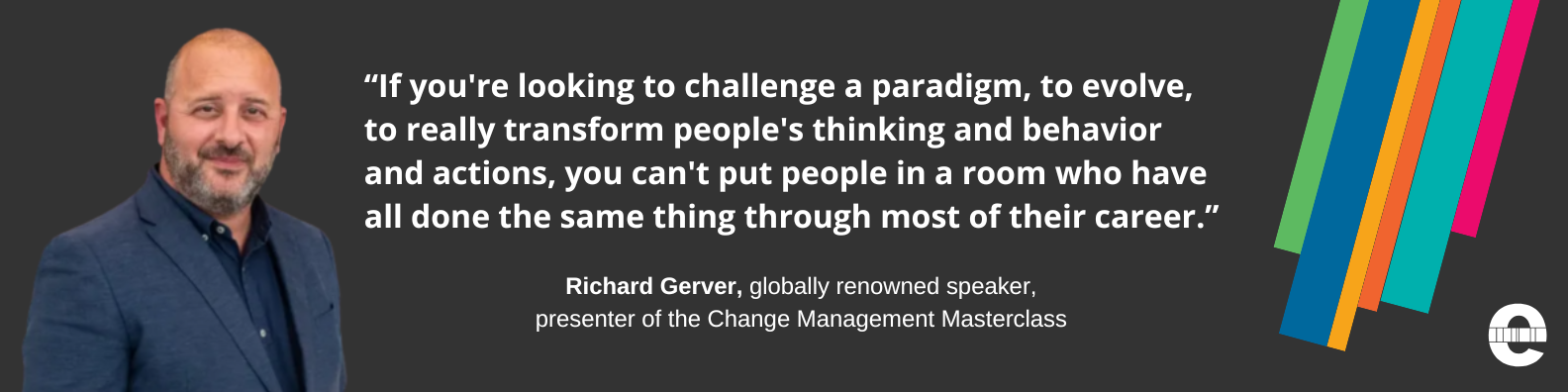
Gerver is direct about this risk. When leadership teams are composed entirely of people who have followed similar paths and share the same viewpoints, innovation becomes difficult. Familiar thinking reinforces familiar outcomes.
He encourages leaders to seek out people who are willing to challenge accepted proof and to value diverse experiences. Difference, in this context, is not disruption for its own sake; it’s fuel for meaningful change.
5. Efficiency-Focused Professional Learning Hinders Progress
“What we've got to stop doing is believing as educators that if we just do what we've always done more efficiently, we will prepare kids for the world,” says Gerver.
Too often, he says, leadership development is designed to help people do what they already do—just more efficiently. While efficiency has value, it doesn't always produce growth. Conversely, when professional learning exposes educators to new environments, industries, and ways of working, it naturally prompts new ideas about what teaching and learning could become, and how it could improve from the present.
6. Education Leaders Can Learn from Other Industries
One strategy that Gerver shares is the value of sending school and district leaders to shadow leaders in other sectors. The opportunity to see how learning, leadership, and problem-solving function beyond schools empowers them to challenge long-held assumptions that education must always work a certain way. Although it wouldn’t make sense to copy a corporate model at a school, it helps leaders observe different contexts and rethink what’s possible in their hallways and classrooms.
7. Fallibility Builds Trust in Leaders and in the Classroom
Fallibility is central to Gerver’s view of leadership. Leaders who focus on appearing all-knowing create distance and fear, but leaders who admit uncertainty, acknowledge weakness, and respect others’ strengths build lasting trust.
Fallibility also humanizes leadership. It invites honesty, surfaces hidden talent, and makes collaboration possible. In both classrooms and organizations, people connect more deeply when leaders allow themselves to just be human.
8. Students Need to Become Skilled at Adapting to Change
Today’s students will be entering a world defined by uncertainty, rapid change, and evolving expectations, says Gerver. Preparing students for the future requires schools to do something more than what they’ve always done. The role of education is not to provide certainty, but to help every student build adaptability, curiosity, and confidence in navigating the unknown.
“We have to create a more proactive community of people if we're truly to help prepare them for the maelstrom of the world as it's going to be,” he says. “The storm's not going to calm; we've got to build new ships.”