
Targeted Skills Instruction Substantially Improves Reading Achievement
Causal research shows struggling students improved their academic trajectory on state assessments because of Targeted Skills Instruction
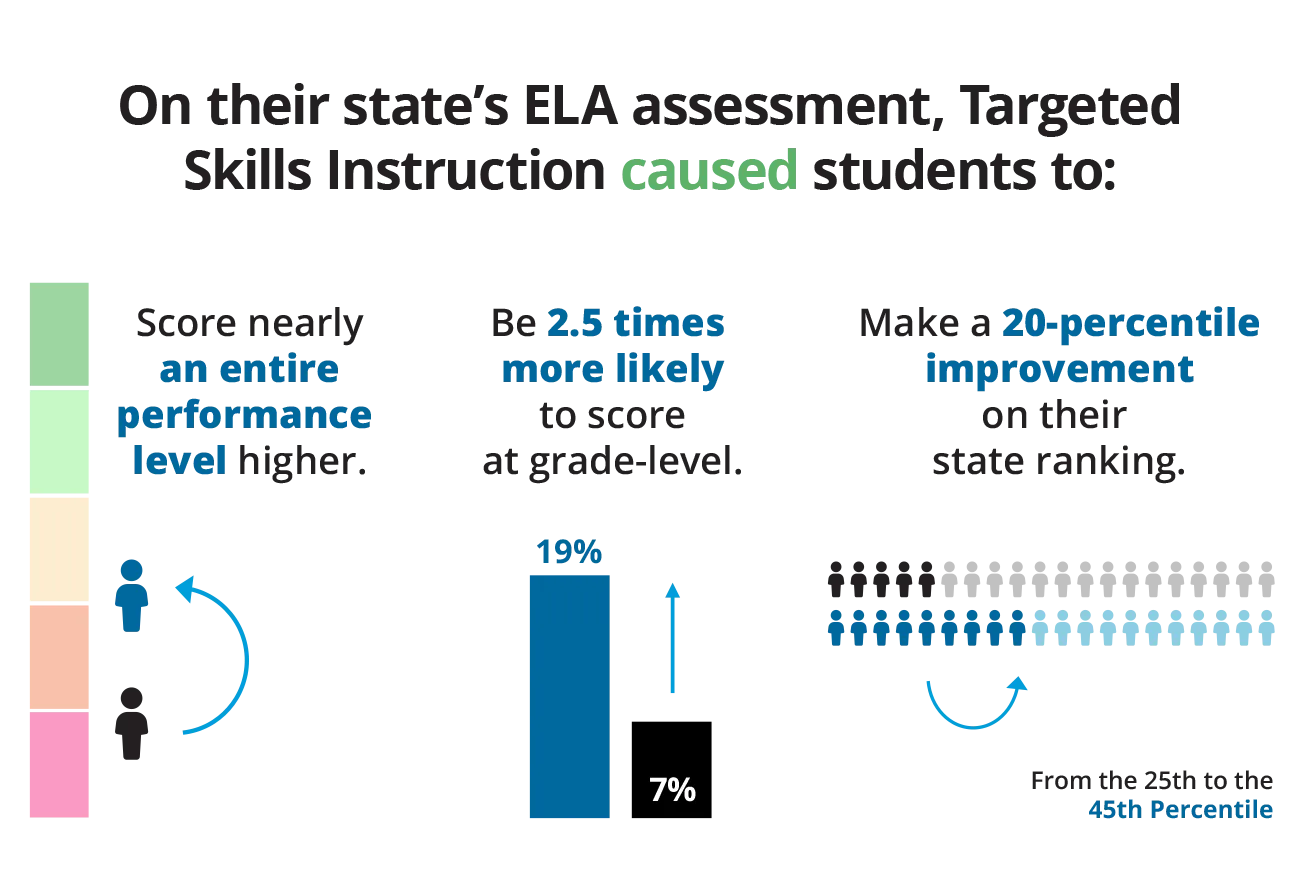
What did we find?
We compared the end-of-year reading achievement of over 2,000 upper elementary students from a large school district in New Jersey who began the year performing below grade-level. These students were practically identical at the beginning of the year, but one group received Targeted Skills Instruction, Edmentum’s virtual small-group tutoring.
Meaningful impact; Accessible to all
These results offer hope to the many districts for whom finding high-quality and experienced local tutors is challenging or expensive. It shows that a well-designed virtual tutoring program can provide students with a critical human connection, use personalized virtual instructional tools to expand tutoring beyond real-time sessions, and be accessible to all districts regardless of local contexts. And, most importantly, it works, especially for the students who are most in need of academic intervention.
Human-centered tutoring that works
This research provides the strongest possible evidence that when struggling students have a human-centered connection to a virtual tutor, like in Targeted Skills Instruction, their reading performance greatly improves.

The efficacy study meets the What Works Clearinghouse (WWC) 5.0 standards without reservations and ESSA criteria for strong evidence (Tier 1).

The program behind the results
Learn more about Targeted Skills Instruction, the award-winning program used in this study, which combines our proven K–12 curricula with qualified virtual educators.
Ready to get started? Get a quote today.
1 “Nearly 1 performance level higher” based on RDD model-based mean difference estimated right at the cut score. This difference was 16.79 and the performance level in which most of these students (“Partially Met”) were estimated to place had a width of 25.
2 “2x more likely to meet expectations” based on RDD model-based mean difference estimated right at the cut score. These means were 723.6 for those receiving TSI and 706.8 for those not receiving TSI. We then assumed a normal distribution around these means with a standard deviation based on indicated effect size (effect size = 0.56; raw difference = 16.8; so SD = 16.8/0.56 = 30) and calculated the probability that a score was 750 or higher.