
Identifying Gaps, Building Momentum: What School Leaders in the Middle East Are Doing Right Now

Every school in the Middle East is navigating a version of the same challenge. Students come with very different experiences, different levels of confidence, and different learning needs. The question is not whether those differences exist, but how schools identify them, respond, and make sure that every learner continues to move forward.
This was the focus of Learning Continuity in Practice: How to Sustain Progress Amid Disruption, hosted by James Hayden, Edmentum's Regional Lead for the Middle East, and facilitated by Gareth Bradwick, International Portfolio Manager.
The webinar brought together Gemma Thornley, Principal at The Arbor School; Dr Tim Hughes, Director of Academic Quality Assurance and School Improvement at Bloom Education; Lee Dabagia, Principal at Summit International School; Jeffrey Sykes, Principal at International Academic School; and Dan Williams, Head of LabSchools at International Schools Partnership (ISP). Together, they addressed some of the most pressing questions facing school leaders right now.
Identifying Gaps Starts with Building Capacity, Not Just Collecting Data
Dr Tim Hughes opened the discussion with a perspective that reframed how leaders should think about gaps in the first place. Rather than treating gaps as a problem to be fixed at the end of each term, he argued that schools should focus on building the capacity of learners to become better learners throughout the year.

Dr Hughes focuses on two main priorities of literacy and assessment. Schools need to stay well informed of assessment data, but more importantly, they need to make that assessment work for them, rather than working around it.
He illustrated this with a striking example. When he asked a group of students what they had last used ChatGPT for, the answers were all content-based. Nobody had thought to ask it how to become a better critical thinker. His point was clear that when schools invest in the skills of learning and metacognition, not just the content of lessons, students develop the capacity to close their own gaps.
Gaps Are Easy to Spot — What Matters Is What You Do Next
Jeffrey Sykes built on this same idea. He explained that the real difficulty lies in deciding what to do with the discrepancies once they're found.
For schools working with large numbers of English language learners, the challenge is not simply identifying that a student is operating two grade levels below their peers, but finding ways to show genuine progress in a manner that is motivating for both students and teachers.
"You have to be creative in the way that you show progress," said Sykes. A student may not have reached the expected attainment level, but they may still have grown considerably. Reframing the conversation around that growth, rather than the gap to a fixed benchmark, changes how both teacher and student experience that progress.
Learning Continuity Is About Belonging, Not Just Pace
Gemma Thornley offered one of the most resonant perspectives of the session, challenging the assumption that continuity means keeping all students moving at the same pace.
"One of the biggest misconceptions in education generally is that fairness means sameness," she said. Students arrive with very different academic experiences and emotional readiness, and effective continuity has to account for all of that.
At The Arbor School, Thornley describes continuity in three layers:
- Connection: students learn best when they feel safe, known, and seen.
- Visible expectations: students need to know what success looks like and be able to access it.
- Responsiveness: using evidence of learning to adapt, challenge, and support in real time.
Thornley believes consistency is about holding the same values and ambition for every student, not the same outcomes on the same timeline. Flexibility belongs to how each student gets there.
Good Targeted Support Feels Invisible
Thornley believes support works best when students don't notice it's happening. The moment it becomes something a student feels singled out for, it risks reinforcing the very opposite it was meant to address.
At The Arbor School, this has meant moving away from the language of intervention and towards the language of access. Support is embedded into everyday practice through adaptive teaching, flexible grouping, multiple ways to demonstrate understanding, and timely feedback.
The school's decision to rename their inclusion department the Thrive Department reflected a genuine shift in how support is understood: not as something separate from the rest of school life, but as the condition that allows every student to flourish.
Technology Can Make Differentiation Look Seamless
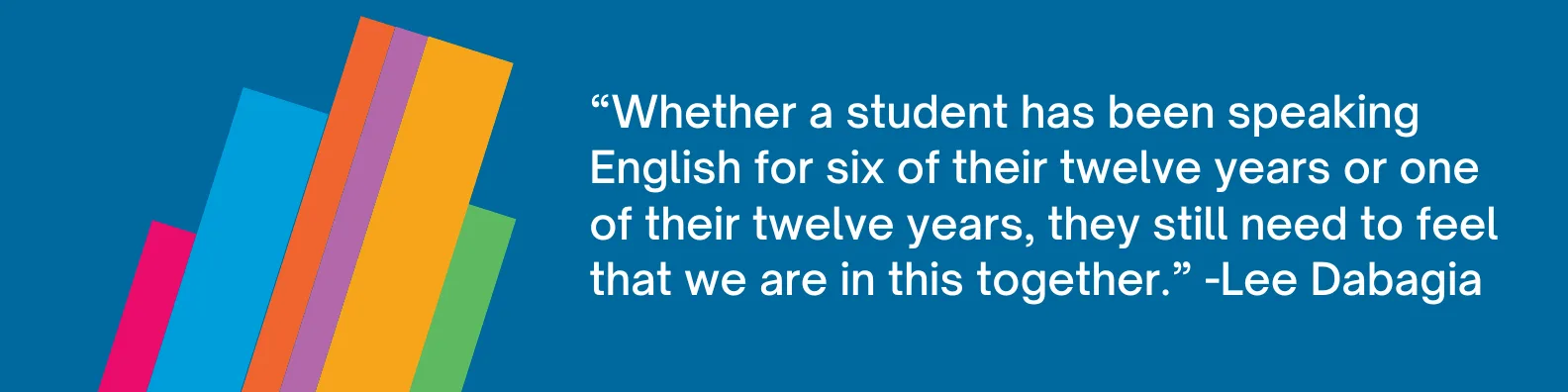
Lee Dabagia took a different angle on the same challenge, focusing on the role that AI and adaptive technology can play in helping teachers reach every student without making the differences between them visible.
A good teacher, he argued, can have a room full of students at entirely different starting points and still make the experience feel unified. Adaptive educational technology now makes this far easier, allowing all learners to engage with material at their own level.
Dabagia noted that in the UAE, schools are already required to place every student into a tiered support structure: Tier 1, 2 or 3. The challenge is not the identification itself but maintaining a sense of shared community in the classroom.
Technology Should Support Teachers
Dan Williams spoke from ISP's experience piloting and then scaling educational technology across its 120 schools globally, nine of which are based in the Middle East. His message was that the best technology is not the most capable tool, but the one built around clearly defined teacher needs.
For ISP, those use cases centred on planning, marking, feedback, and targeted student support through an AI tutor. They also built a focus on life competencies, or the skills beyond academic performance that parents consistently identified as priorities for their children.
His practical advice for schools considering similar approaches was to focus on what they want the technology to do, rather than getting drawn in by everything it can do.
From Data to Action: How Exact Path Supported Two Schools
Both Lee Dabagia and Jeffrey Sykes spoke about how Edmentum's Exact Path has helped move gap identification into meaningful action.
Dabagia found that many students lacked access to books at home, so his school used Exact Path to give each student automatically differentiated reading at their own level. He credited this with directly contributing to the school's NWEA MAP results, which improved across every grade from one to ten, with reading gains of six to twenty points.
For Sykes, the bigger shift has been in teacher dynamics. Rather than serving every tier of learner at once, teachers can now set students onto their own path, letting them act as facilitators while students keep progressing and those who need extra support get it without delay.
What Evidence Should Leaders Actually Be Asking For?
Dr Hughes was asked what evidence school leaders should demand when evaluating whether an intervention is working. His answer challenged the tendency to collect data for its own sake, pointing out that most schools need to use the data they already have well instead of collecting more.
He described a clear cycle: find out where learners are, understand where they should be, agree on the actions required, and then ask how far they have come. Crucially, that cycle should involve students themselves.
On frequency, his research encouraged leaders to rethink what evidence collection looks like in practice: fewer lengthy written reports, and more purposeful discussion groups and learning walks, including involving students themselves as trained observers on those walks. His underlying message was that less is more, so long as the assessment process is designed to do the heavy lifting, rather than teachers.
Ending the Year Well Means Starting the Next Year Early
With the end of the academic year approaching, the conversation turned to how schools can finish strong while setting students up for a confident start in the fall.
Dr Hughes described how his schools had restructured the academic year entirely. Younger students were promoted early, meaning they arrived back in September with half a term's work already done. As a result, September no longer felt like such a daunting restart, and the parental complaints about wasted time at the end of the previous year simply disappeared.
He also spoke about the benefits of vertical teaching groups, combining Year 10 and Year 11 students in a single-year GCSE model. In practice, Year 10 students outperformed Year 11s, and he described it as a genuinely powerful way of maintaining continuity and making the best use of time.
Thornley echoed this, describing how her school is trying to treat Term 3 as a launch point rather than a wind-down, a transition that moves students forward. Giving students early visibility of what's coming, and making sure any pre-teaching material is already in place, was something she stressed as particularly important.
Momentum That Lasts
Across five very different schools, the message from this conversation was remarkably consistent. Closing a gap isn't only about the numbers, it’s about helping students believe they can close it on their own. These leaders are showing that momentum comes from small, deliberate choices made consistently.
If you'd like to learn more about how schools can use diagnostic insights to move from assessment to action, you may be interested in this discussion.
If these ideas resonate, there’s plenty more in the full conversation.
Watch the webinar to hear what Gemma Thornley, Dr Tim Hughes, Lee Dabagia, Jeffrey Skyes, and Dan Williams have to say about what Learning Continuity Looks Like in Practice. They go even deeper into what’s working in their schools right now and can give you a chance to pick up a few ideas of your own for finishing this year strong and starting the next one even stronger.