How "Gatebreaking” Math Intervention Helps Struggling Students Succeed in Mathematics and Beyond

Guest article by Juliana Tapper, M.Ed
Students Who Struggle: Defined
Every school has students who “struggle with math,” but what does that truly mean? In my book, Teaching 6-12 Math Intervention, I define students who struggle as “any student who consistently finds it difficult to understand, engage with, or succeed in mathematics courses.” These are the students who enter math classrooms already convinced they will fail. They carry math anxiety, foundational skill gaps, or repeated experiences of failure that compound into a belief that they “just aren’t math people.”
Sometimes, they act out, check out, or quietly withdraw. Other times, they appear to comply but are completely lost. It’s not that these students are incapable; it’s that they are stuck in cycles of confusion, fear, and disengagement that make learning math feel impossible.
Why We Need to Intervene When Students Struggle with Math
When students struggle repeatedly with math in any grade, it becomes a gatekeeper, preventing them from advancing with their peers, keeping them from feeling like confident mathematicians, or placing them into intervention pull-out groups, branding them with the “low group” tag. Even though Algebra 1 might be the most notorious gatekeeper, each and every grade level prior to Algebra 1 plays a role in either closing or opening the gate to success and achievement in mathematics. The reason Algebra 1 carries all the pressure is because it is the final gate to higher academic achievement and success. When students pass Algebra 1, they unlock the gate to higher-level math courses which are needed for high school graduation and college acceptance.
Knowledge is power, but more specifically, math is power. When we can help students succeed in math at all grade levels, we literally change their educational trajectory. It sounds ridiculous, but as educators, we know it’s true.
So how do we stop this gatekeeping? Before we can jump to action, we must first understand on a deeper level why so many students are struggling with and failing math at such high rates. We must understand the gatekeeping cycles of mathematics.
The Gatekeeping Cycles of Mathematics
There are three cycles that make up the gatekeeping of mathematics, and we can think of these cycles as gates. These gates are in the way of increasing outcomes for students who struggle with math in our current education system. There is a student gate, a teacher gate, and a systemic gate. Some students are stuck behind one gate, repeating the cycle over and over again, and some students start within one cycle and get flung around, only to be met with another gate as they find themselves stuck in yet another cycle.
- Student Gate: Math trauma and math anxiety create fear around engaging in math. Students carry these experiences with them, affecting participation, content retention, and confidence.
- Teacher Gate: Teachers, often unconsciously, lower expectations based on diagnostic data resulting in endless remediation rather than grade-level learning. Implicit bias can shape who gets called on, who gets placed in remedial courses, and who feels they belong in advanced mathematics courses.
- Systemic Gate: Structural practices such as deficit labeling (“low kids”) and tracking into remedial classes disproportionately impact students of color, multilingual learners, and students with disabilities. These practices limit students’ access to grade-level content and advanced coursework, perpetuating cycles of underachievement.
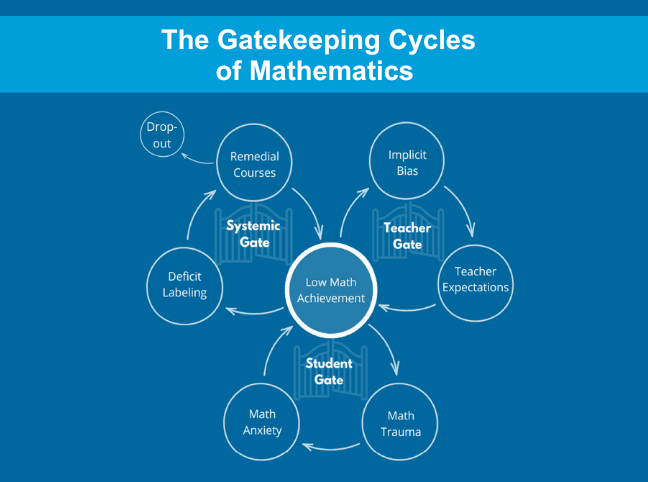
From Juliana Tapper’s, Teaching 6-12 Math Intervention (Tapper, 2025): The Gatekeeping Cycles of Mathematics: Made up of a Student Gate, Teacher Gate, Systemic Gate
Be a Math Gatebreaker
While the gates I’ve identified paint a bleak picture, there is hope. You can become a math gatebreaker. To be a math gatebreaker is to help any student who struggles with math recover their mathematical confidence, find academic success, and achieve at high levels in mathematics; thereby breaking the gates that have held them back. There are three areas of focus for administrators to guide their staff in becoming gatebreakers instead of gatekeepers at all levels of K-12 education.
#1 Just In Time Intervention
There are two models of math intervention: "Just in Case" and "Just in Time."
- Just in case fills all the holes students have, just in case they missed them in prior grade levels.
- Just in time fills the gaps that are needed for success with immediately upcoming grade-level content.
Intervention should not mean endless and pointless remediation. Support your teachers in using a "just in time” approach to intervention that fills gaps within the context of grade-level learning instead of wasting their time learning prior grade-level standards that are not essential for grade-level success.
#2 Focus on Essential Grade Level Content
When you adopt a just in time approach to intervention, your teachers cannot get through the entire curriculum. You must help them understand what is essential for their grade level and what is okay to skip, and then encourage them to skip it (this is very hard for math teachers). Using a resource like Student Achievement Partners Focus by Grade Level is a great starting point.
#3 Make Content Accessible
This is made up of two parts: what we teach and how we teach it. First, help teachers understand what to teach. When our schools are filled with students who struggle with math and we hand our teachers a newly adopted, high-quality curriculum, it can feel overwhelming and out of reach. The truth is that high-quality curriculum cannot contain prior grade-level standards or content, but the reality is that our students need a scaffold in order to reach the grade-level content in the curriculum. You must allow teachers to create a just in time intervention plan to adequately scaffold to grade-level content because they will not find this in their textbooks.
Secondly, encourage your teachers to explore how to teach students who struggle. While the math world is currently heavily focused on inquiry-based instruction, I believe the key to becoming a gatebreaker in mathematics is explicit instruction. My Math Wars Method®, outlined in my book as well as my digital PD program, combines elements of gradual release of responsibility, formative assessment, and meaningful collaboration to create an effective, explicit instruction model that boasts an average 46% increase in daily student engagement and 20% higher course pass rates within one semester of implementation.

I hope this post has provided insight into why students struggle with math and how you—and your staff—can become a math gatebreaker and change the educational trajectory of the students who need it the most. For more tips, strategies, and activities, grab a copy of my book, Teaching 6-12 Math Intervention: A Practical Framework To Engage Students Who Struggle.
References
National Center for Education Statistics. (2023). Mathematics Performance. Condition of Education. U.S. Department of Education, Institute of Education Sciences. Retrieved 6/5/24, from https://nces.ed.gov/programs/coe/indicator/cnc.
Schachter, R. (2013). Solving our algebra problem: Getting all students through algebra I to improve graduation rates. District Administration, 49(5), 43-46.
Tapper, J. (2025). Teaching 6-12 Math Intervention: A Practical Framework To Engage Students Who Struggle. Routledge.
U.S. Department of Education. (1997). Mathematics equals opportunity. [White Paper prepared for U.S. Secretary of Education, Richard Riley, ED 415-119]. https://files.eric.ed.gov/fulltext/ED415119.pdf
Related Resources
- [Article] To Get Algebra 1 Right, Rethink What Comes Before: Gain an overview of the key predecessor skills for Algebra 1 and learn about the importance of instructional coherence.
- [Webinar] How to Equip Students for High School Math Success: In this panel discussion, learn what the research says about key Algebra 1 predecessor skills and how middle schools can provide targeted instruction.
- Acceleration Toolkit: Get proven strategies and digital resources to close learning gaps, accelerate student growth, and implement targeted interventions in math, reading, and language arts.