Video in Digital Education: What Does the Research Actually Say?

by Dr. Jayne Lammers, Director, Learning Design and Jen Perry, Sr. Manager, Learning Design
Every day, millions of students interact with digital learning platforms. Too many of these experiences prioritize attention over learning, clicks over comprehension, and entertainment over education. At Edmentum, we've built our reputation on refusing these false choices. Our learning design principles prove that rigorous, research-backed instruction can be both effective and engaging—a commitment to quality that has earned us Digital Promise's Research-Based Design certification for meeting rigorous research standards without sacrificing educational integrity for entertainment value.
While streaming platforms like Netflix and social media sites like TikTok and YouTube encourage binge watching, there can be downsides to structuring a digital education curriculum through a video-first lens. Platforms designed to trap viewers’ attention prioritize continuous watching and more clicks; retention of knowledge is not their goal. These platforms play to quantity-over-quality, leading Netflix itself to admit that quality suffered as they structured their business to churn out quantity.
If you’ve used any of these platforms, you know the experience: you have to sort through lots of noise and subpar content before you find the quality entertainment or information you truly appreciate. You may also have experienced the sense that each new movie, show, or short video feels just like the last. We can spend hours binge-watching or scrolling through content, but come away with no tangible, memorable experience. This happens because, as the authors of Brain Wash note:
“Technology can disconnect us from our high-level brains by promoting mindless activity. Our ability to be thoughtful, focused, and present gets squandered when we turn our attention to clickbait, an endless scroll of newsfeeds, or an unbroken video queue. When we finally step out of the nearly unconscious state in which we pursue these activities, we realize how much time has vanished and how little we have to show for it—certainly nothing productive. Our brains might as well have been hibernating.” (p. 59)
While bad enough that these practices have been changing our media landscape, we find it particularly worrisome when education companies say they want to create products as bingeable as popular Netflix series or “engaging” as an influencer’s TikTok feed. At Edmentum, we refuse to compromise on educational quality, and we certainly don’t want students’ brains to “hibernate,” when they should have experiences and environments designed for active learning. Quality is essential to us, and engagement means more than attention. It requires research-based design to ensure learning that sticks.
We build products that get recognized as best-in-class education. Their impact is demonstrated by rigorous research on the student outcomes that matter, including attendance and NWEA MAP Growth scores. As an Educator First company, we invest in the most talented teachers and development teams with education and learning sciences expertise, not cinematographers, to design research-driven solutions to ignite student potential. We also partner with schools to support successful implementations so that students build healthy connections to the educators around them, enhancing learners’ motivation. This article offers some real talk about the role videos play in the design of research-based digital education products that provide quality learning experiences for all students.
Getting Real About the Research on Video
Videos have been touted as the way to catch students’ attention in today’s world, thus the earlier Netflix, YouTube, and TikTok comparisons. Research does support specific uses of video to enhance learning, but with clear implications for quality and planning for engagement. These researchers argue that “videos produced with a more personal feel could be more engaging than high-fidelity studio recordings,” and recommend: “try filming in an informal setting; it might not be necessary to invest in big-budget studio productions” (p. 2).
While it may be true that we all spend more time on our devices consuming video and using online videos as resources for quick learning or problem-solving, it is not clear that these popular and available videos alone produce the best results for learning and retention. One of the key findings from the whitepaper Assessing the Impact of Educational Video on Student Engagement, Critical thinking and Learning: The Current State of Play acknowledges that “very little is known about video’s role in knowledge development and helping critical thinking, and this is identified as a major gap in the research that requires more investigation” (p. 5).
To this point, research has found interactive videos to be “at least comparable to that of print” when it comes to effectiveness for learning—indicating that video can be effective, but that the purposeful use, not the medium, is the answer in teaching and learning. For example, videos can explain concepts in engaging ways, and they are especially useful in helping students gain access to events, time periods, and phenomena that they cannot experience in their lives or classrooms. For these reasons, we purposefully use video in our products.
At Edmentum, we incorporate video to explain complex concepts, guide student learning, and strategically increase engagement. We use video to:
- Reduce the cognitive load on learners with multimodal explanations.
- Animate intangible, abstract, or hard-to-see phenomena, like DNA, weather, chemical reactions, etc.
- Illustrate the use of manipulatives in problem solving.
- Simulate hands-on experiences in the virtual realm.
- Share authentic stories from diverse voices.
- Model steps in a process.
- Summarize and recap what students have learned.
Meeting the Needs of All Learners
While videos are indeed a powerful tool for learning when used in the context of research-driven strategies, they are not the answer for every student nor every lesson. At Edmentum, we design for the millions of students in classrooms around the globe who learn with our products. To consider the needs of such a diverse student population, we look to research on learner variability, defined by Digital Promise as “the recognition that each student has a unique set of strengths and challenges across a whole learner framework that are interconnected and vary according to context.” Our curriculum must use multiple strategies to support students’ success, just as our educators and instructional designers must think beyond what works for themselves as learners.
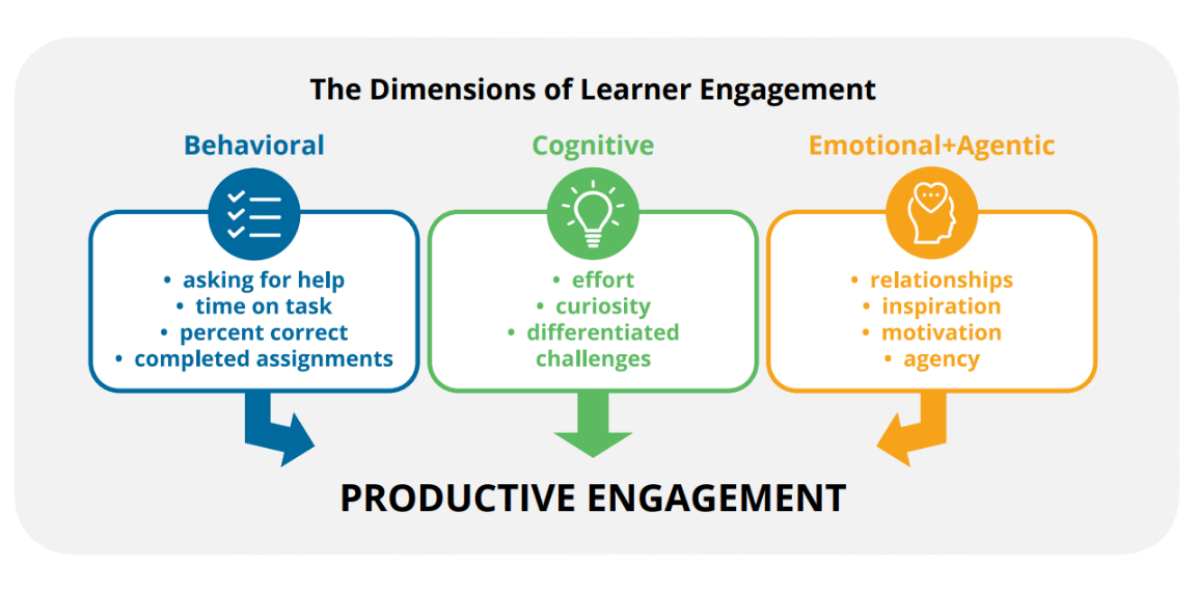
We create targeted and personalized learning for intervention and acceleration, not just clickbait. Therefore, each component of our instruction, whether video, narrative, graphic organizer, guided notes, activities, or assessments, leverages innovative design to give a variety of learners an opportunity to thrive. We catch students’ attention through productive learner engagement, defined by active, not passive, interaction with learning across these dimensions of engagement: behavioral, cognitive, emotional, and agentic.
Designing Educational Videos for Learning
Finally, we know that when we use video, we need to keep in mind the following considerations.
- Quality Control: We realize that finding high-quality educational videos can be challenging. We design our videos thoughtfully, using multiple strategies to elevate learning and very carefully source what we don’t create ourselves.
- Overreliance: We know that relying solely on videos may limit active learning, so we use them as a strategic tool and in conjunction with multiple strategies for productive engagement.
- Attention Span: We understand the research about what video lengths have the highest impact to increase retention and create success on assessments. We work to balance brevity with conveying content depth.
- Efficacy: We acknowledge that attributing learning outcomes to videos can be tricky. We will continue to monitor the learning science, design our products accordingly, and conduct research studies to evaluate the impact of our programs on outcomes that matter.
At Edmentum, we know that when you pair our comprehensive, research-backed learning acceleration solutions with empowered and supported educators, you can change the direction of students’ lives. Creating such impact means following the science to inform thoughtful instructional design that utilizes all the tools available to productively engage learners. Video will remain one of our tools, not our solution, for producing quality education products.
Ready to change student outcomes with high-quality digital curriculum? Edmentum Courseware consistently wins top industry recognitions as the leading courses and courseware solution. With more than 500 courses, including a comprehensive CTE library with 180 semesters and nearly 60 career pathways, Courseware gives all students grades 6-12 access to the classes they need. It’s built on key learning design principles and backed by ESSA Tier II efficacy research, demonstrating real impact for real students like yours. Learn more today.
About the authors
Dr. Jayne Lammers is Director of Learning Design for Edmentum. With expertise in literacy, particularly adolescent literacy and digital literacy, learning design, teacher education, and online education, she is skilled at translating learning sciences research into practical applications for a variety of stakeholders. Her academic research explored adolescents' uses of technology for their own interest-driven learning. She also conducted classroom-based research to study teachers' uses of technology in a variety of contexts, not only literacy but also in science.
Dr. Lammers taught middle school Reading and ELA and high school Reading in Orange County Public Schools, FL, and taught teacher education, literacy theory, and research methods courses at Arizona State University and the University of Rochester. She co-founded the Center for Learning in the Digital Age at University of Rochester, developing expertise in faculty professional development for technology-enhanced teaching and learning and online education.
Jen Perry is Sr. Manager of Learning Design at Edmentum. She worked for 30+ years with youth in educational and community settings, including as a teacher, administrator, and trainer. Her passion has been to help educators develop an understanding of the importance of the whole learner in learning pedagogy. At Edmentum, Jen works to help support research-based product development and curriculum design.
As a thought leader for Edmentum she speaks nationally and internationally on the impact of evolving brain science on teaching practice. Jen has worked in a wide variety of settings from teaching and coaching at elite boarding schools to serving in an administrative capacity a K-12 residential facility, and as a program manager for a juvenile diversion and two non-secure detention facilities. She has participated in research on the impact of Adverse Childhood Experiences (ACEs) on learning and health outcomes, and the application of the SEARCH Institutes SPARKS curriculum on the outcomes of youth at promise, a demographic of youth with a high prevalence of dyslexia.