
Courseware Helped Students Recover More Credits in Baltimore
Courseware gave students with multiple summer school classes the flexibility to be more successful and to recover more credits, without compromising rigor or integrity.
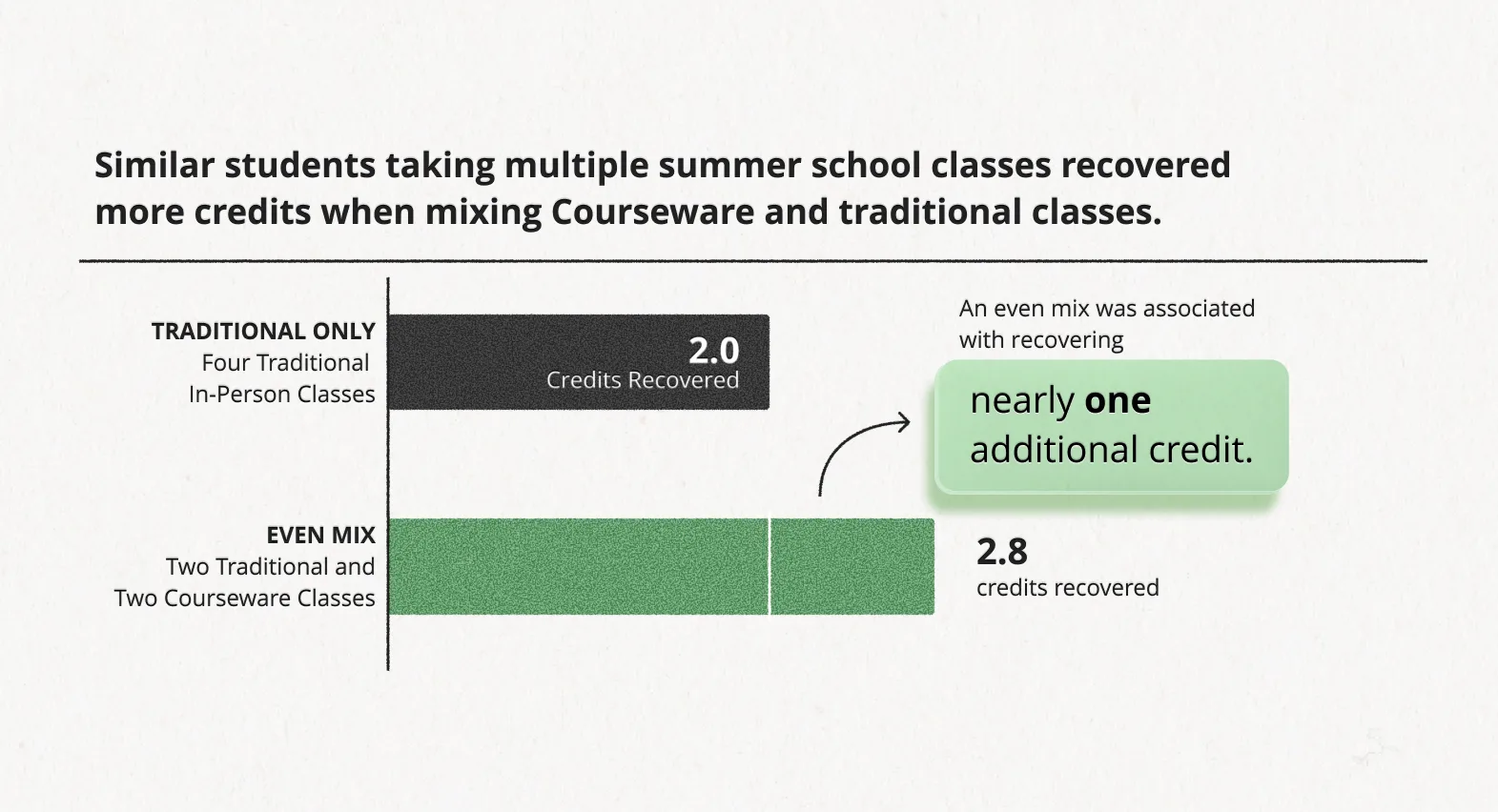
Note: Results based on data from 2024 Baltimore City Public Schools summer credit recovery courses. Most students in data took multiple summer school courses; the average summer school student took three credit recovery classes. Successful credit recovery rates for both scenarios above estimated from a logistic regression model controlling for race/ethnicity, prior GPA, and other student characteristics. Success probabilities estimated for Black female students with a prior GPA of 1.9, a prior course completion rate of 50%, and not enrolled in special education or classified as an English Language Learner – these values were chosen to reflect a student near the district average. Model estimates used because of small sample sizes for some combinations and to account for differences between students, though results based on raw percentages were qualitatively similar. Estimated credits recovered based on success rates multiplied by attempted credits (4).
What did we find?
Independent researchers looked at students who completed courses for credit recovery in Baltimore City Public Schools, asking whether students recovered more credit if courses using Courseware were part of their schedule. This included over 10,000 course enrollments from the summer of 2024. Many students had substantial need for credit recovery, with the average student taking three summer courses.

This study was conducted by Empirical Education, an independent third-party organization that has been conducting research, experiments, and program evaluations for over 20 years.
Creating real opportunities to recover multiple credits
Credit recovery offers students a chance to earn credit in courses they failed, keeping them on track to graduate high school; a milestone linked to significantly better long-term economic, social, and health outcomes. In one out of 10 schools, 20% or more of the students are enrolled in at least one credit recovery class.1 Nationally, credit recovery enrollment rose 13% between the 2017-18 and 2023-24 school years following the pandemic, according to a Chalkbeat analysis of federal data.2 Yet, many schools report obstacles to providing effective credit recovery options, commonly citing lack of time during the school day and lack of staff for summer school.3
This study found that the digital courses provided by Courseware allowed students to take multiple courses with greater success. When students attempted to recover multiple credits solely through traditional district-led summer school classes, their success rates plummeted as their course load grew. But students who evenly mixed digital-based Courseware courses with traditional courses maintained a relatively high success rate and tended to recover more credits.
More success for those needing to recover multiple credits
This study found that the more credits students needed to recover, the more important Courseware became. For students who needed to recover multiple credits, Courseware provided students with critical flexibility to make success a reality.
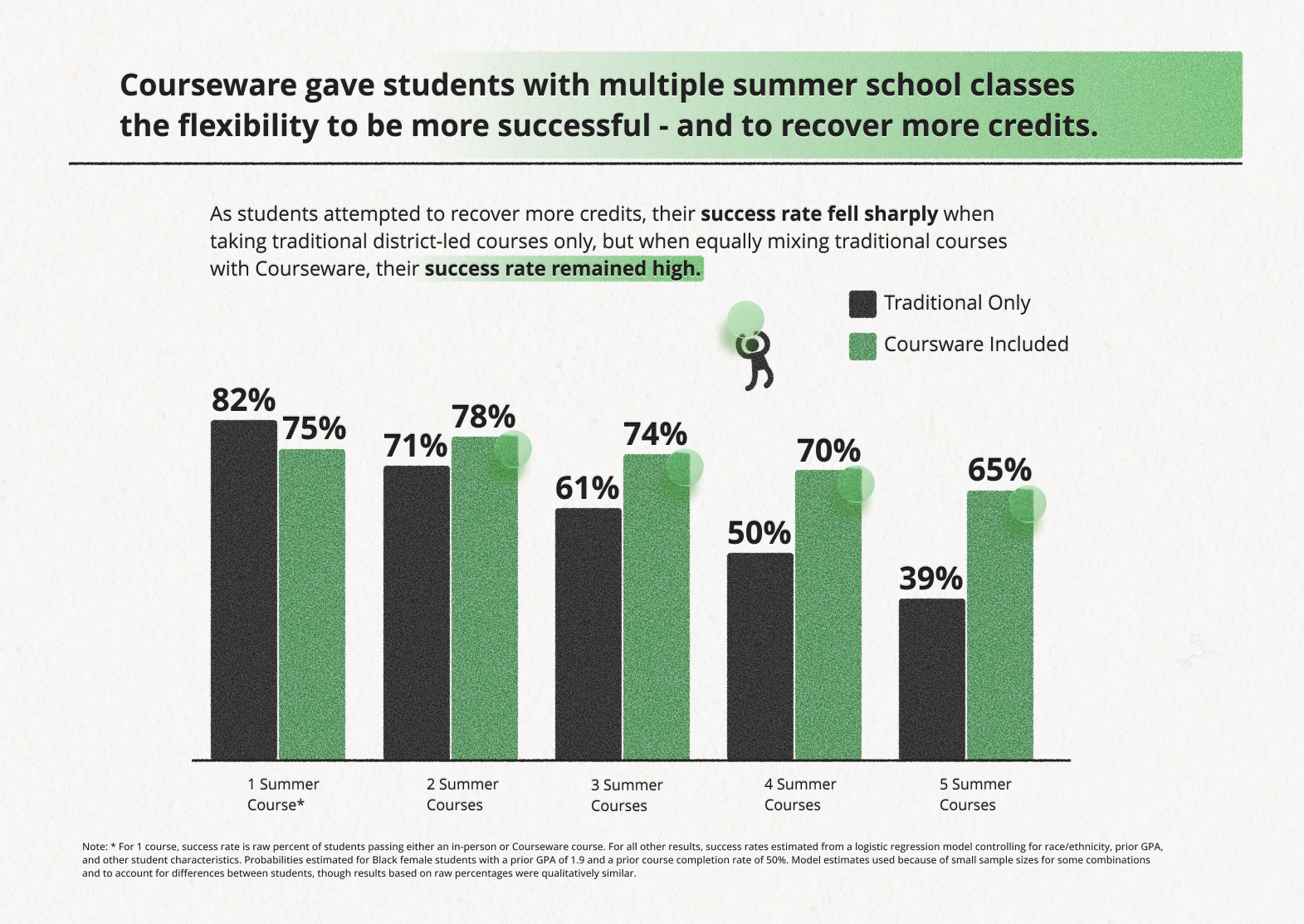
Courseware applies the same rigorous standards to credit recovery as to first-time course enrollment, so Baltimore students earn high-quality credits.
What could this look like in your district?
Whether you’re rethinking summer school or exploring credit recovery options, we can help you build a program that meets your unique needs.
FAQs: Credit Recovery with Edmentum Courseware
Key questions this research helps answer.
1 Thomas B. Fordham Institute: Credit Recovery – Good Intentions, Poor Execution Petrilli & Northern (2018).
2 Chalkbeat: Credit Recovery Enrollment Rose 13% Since 2017, Raising Questions About Graduation Rigor Altavena (2026)
3 AIR Research Brief 12: Landscape of High School Credit Recovery in U.S. Public Schools: Perspectives from District Leaders Clements & Rickles (2024).